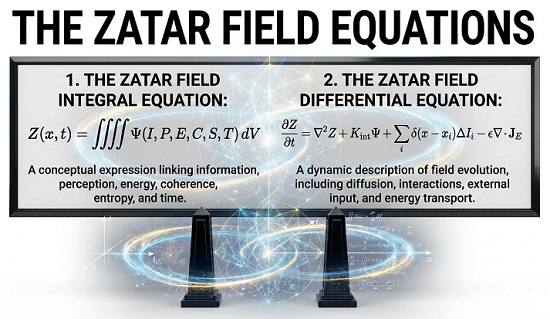
The Zatar Field is a conceptual framework and exploratory hypothesis proposed by author and consciousness researcher Tom Zatar Kay in his book series The Zatar Field Series on Amazon. It suggests that consciousness, human awareness, memory, creativity, intuition, and information might all be interconnected through a deeper, underlying energy field in the universe.
For thousands of years, humanity has searched for answers to life's biggest questions.
What is consciousness?
Why are intuition, creativity, inspiration, and seemingly impossible coincidences part of the human experience?
Could science eventually discover that everything in the universe is connected through a deeper level of reality?
These are the questions explored throughout The Zatar Field Series, an 13-book collection that examines consciousness through the lenses of science, philosophy, psychology, spirituality, artificial intelligence, and personal growth.
The central idea behind the series is The Zatar Field—a proposed conceptual framework suggesting that awareness, memory, information, creativity, emotion, and human experience may be interconnected in ways we are only beginning to understand. It is presented as an exploratory hypothesis rather than an established scientific theory, inviting readers to examine ideas from multiple disciplines and consider how they might fit together.
Modern science has transformed our understanding of the physical universe. Quantum mechanics has revealed a reality stranger than classical physics imagined. Neuroscience continues to investigate consciousness, while artificial intelligence forces us to ask entirely new questions about intelligence, awareness, and what it means to be human.
The Zatar Field Series explores these developments while encouraging readers to think beyond traditional boundaries.
The series is designed so that each volume explores a different aspect of the larger picture.
Zatar Field Einstein's Unfinished Dream Explore a bold new hypothesis that could transform our understanding of consciousness, energy, matter, and the universe.
Building on Einstein’s unfinished search for a unified reality, Tom Zatar Kay introduces two proposed equations connecting physics, information, perception, and spacetime.
Discover groundbreaking ideas, fascinating scientific illustrations, and five proposed experiments designed to put the Zatar Field hypothesis to the test.
A potentially historic scientific challenge inviting researchers worldwide to explore the deepest mysteries of existence—and discover whether reality is more interconnected than we ever imagined.
The Zatar Field Brain Food A brief introduction to the central question of the book: whether information, energy, coherence, entropy, perception, and temporal structure could be connected through a deeper physical framework. The introduction establishes that the Zatar Field is a proposed, testable hypothesis rather than established science, and explains that experiment must ultimately determine whether the idea corresponds to something real.
To Speak the Spirits
The book that began the journey introduces readers to intuition, spirituality, dreams, synchronicity, and the possibility that consciousness extends beyond ordinary experience.
Zatar Field Equation Unify - Explain - Empower. A bold interdisciplinary hypothesis that combines information theory, neuroscience, artificial intelligence, thermodynamics, complexity science, and modern physics into a single conceptual framework. Written in the style of a scholarly scientific monograph, it explores one of the most fascinating questions in science: Is there a deeper organizing principle underlying consciousness and the universe itself?
The Unified Zatar Field Paradigm
Consciousness is Magic, Explores One of The Biggest Unanswered Questions in Science.
The Zatar Field
The foundational volume explains the overall concept of the Zatar Field and explores how consciousness, memory, creativity, and information might fit into a larger interconnected reality.
Scientific Proof of the Existence of the Zatar Field
This volume explores ideas from quantum mechanics, information theory, neuroscience, electromagnetic theories of consciousness, artificial intelligence, Orch-OR theory, the Zero Point Field, and other scientific concepts that the author discusses in relation to the Zatar Field hypothesis. Readers are encouraged to distinguish between established scientific findings and the book's broader interpretive framework.
The Zatar Field: Miracles
This book examines extraordinary human experiences, including intuition, remarkable recoveries, synchronicity, spiritual awakenings, and near-death experiences, asking whether these events reveal patterns that deserve deeper exploration.
The Unified Zatar Field Theory Hypothesis
This volume attempts to organize the author's ideas into a single conceptual model linking consciousness, perception, information, time, entropy, and energy.
The Zatar Field Children's Book
Young readers are introduced to kindness, curiosity, creativity, compassion, and interconnectedness through colorful storytelling and illustrations.
Zatar Field: Inner Energy, Outer Energy, and Our Superpowers
This practical guide explores personality, emotional intelligence, purpose, self-discovery, and human potential, encouraging readers to recognize their unique strengths.
The Zatar Field: Overcoming Addiction
Recovery is presented as a journey toward purpose, mindfulness, hope, and resilience, emphasizing personal growth and inner transformation.
Why This Matters
Whether or not the Zatar Field ultimately proves to be a useful way of understanding consciousness, the questions it raises are increasingly relevant. Advances in neuroscience, quantum physics, psychology, and artificial intelligence continue to reshape how we think about the mind and reality itself.
The Zatar Field Series encourages readers to explore these ideas with curiosity, to compare them with current scientific understanding, and to think critically about the mysteries that remain unsolved.
For readers interested in consciousness, spirituality, human potential, creativity, and the future of technology, the series offers a broad invitation to explore one of humanity's most enduring questions:
How deeply are we all connected?
The Zatar Field is a paradigm shift that yields several profound conceptual and philosophical benefits for how humans view themselves and the cosmos:
1. A Unified View of Reality
In traditional physics, inanimate matter and conscious thought are often studied using entirely different rulebooks. The Zatar Field equation attempts to mathematically bridge this gap. By treating consciousness, information, and energy as components of the same underlying field, it offers a worldview where mind and matter are deeply interconnected, rather than separate or accidental.
2. Validation of Human Experiences
Kay suggests that if such an underlying field exists, it would provide a scientific basis for extraordinary human experiences that current mainstream science struggles to explain. These include:
• Intuition and Inspiration: Sudden flashes of genius or creativity might be explained as tuning into the field's information density.
• Synchronicity: Meaningful coincidences could be viewed as predictable, structural intersections within the field, rather than just random luck.
• Memory and Awareness: The field is hypothesized to act as a cosmic fabric that retains and organizes memory and human awareness.
3. A Guide for Artificial Intelligence & Biology
By introducing a "mathematical maturity ladder" for how complexity emerges, the framework aims to inspire new ways of looking at complex systems. It suggests that understanding the interaction between information and coherence could help scientists better model how lifeless molecules organize into living cells, and how complex networks transition into genuine artificial intelligence.
The structure of the Zatar Field Dynamical Equation provides insight into how author Tom Zatar Kay borrows mathematical architecture from mainstream physics to frame his speculative hypothesis.
Kay explicitly positions his hypothesis as a potential path toward resolving Einstein's unified field problem—the century-long quest to unite gravity with the other forces of nature. To make his ideas sound plausible within that tradition, the equation relies heavily on structural elements borrowed from General Relativity and Quantum Field Theory.
The Zatar Field Dynamical Equation is formulated as follows:
\(\Box _{(g)}Z+m_{Z}^{2}Z=J_{Z}(I,P,\epsilon ,C,s,\sigma ,\mathcal{T})\)
1. Left Side of the Equation: Borrowing the Fabric of Spacetime
In Einstein’s General Relativity, gravity is not an active pulling force; it is the physical curvature of the spacetime fabric caused by mass and energy (\(G_{\mu \nu }\)). When physicists want to model how a fundamental field (like the Higgs field) moves through this curved, dynamic Einsteinian spacetime, they use a specific calculus operator.
• The D'Alembertian Operator (\(\Box _{(g)}\)): Kay utilizes this symbol, which is the differential operator representing how waves propagate through a curved space governed by a gravitational metric (\(g\)). By using \(\Box _{(g)}\), the formula structurally asserts that the Zatar Field is bound by and subject to the laws of Einstein’s curved spacetime.
• The Mass-Field Term (\(m_{Z}^{2}Z\)): This borrows language from the Klein-Gordon equation in relativistic quantum mechanics, which describes the behavior of massive scalar particles. By including it, the framework attempts to model the Zatar Field as a tangible, physical scalar field possessing its own mass-energy characteristics.
2. Right Side of the Equation: Borrowing the "Source" Concept
The conceptual mirror to General Relativity is found on the right side of the equation. In Einstein's field equations, the right-hand side contains the Stress-Energy Tensor (\(T_{\mu \nu }\)), which mathematically describes the "sources" of gravity: the distribution of mass, energy, pressure, and momentum. The core rule of relativity is that matter tells spacetime how to curve, and curved spacetime tells matter how to move.
• The Zatar Source Current (\(J_{Z}\)): Kay replaces Einstein’s material stress-energy tensor with a custom source current (\(J_{Z}\)).
• The "Matter" of Consciousness: Instead of just mass and energy warping the field, the equation claims that the field's dynamics are actively generated by a mix of physical and non-physical variables: Information (\(I\)), Perception (\(P\)), Energy (\(\epsilon \)), Coherence (\(C\)), Entropy (\(s\)), Charge (\(\sigma \)), and Temporal Geometry (\(\mathcal{T}\)).
4. Encouraging Open Scientific Inquiry
From a methodological standpoint, Kay presents the project as a positive challenge to modern science. By organizing his ideas into a rigid, scholarly monograph format with specific experimental guidelines, he encourages researchers to test boundaries, challenge assumptions, and explore "contrarian" frameworks rather than settling into rigid academic silos.
Part 1: The 5 Proposed Experiments
Because the Zatar Field is treated as a massive scalar field (\(m_{Z}\)) that couples to an operationally defined Information Variable (\(I\)), the testing strategy relies on a controlled, isolated apparatus to see if shifting information states generates a microscopic, unexplained physical residual (force or acceleration).
[ Predetermined Binary Sequence ] ? [ Shifting Information Rate (?I) ]
?
[ Differential Force Sensor ] ? [ Sourced Zatar Field (?Z) ]
Experiment 1: The Phase I Pilot Baseline
• The Setup: A rigid, enclosed optical modulation system (using lasers or LEDs) is placed roughly 1 meter away from a highly sensitive differential force sensor.
• The Test: The source switches between a highly structured binary pattern (low information/entropy rate) and a highly randomized binary pattern (high information/entropy rate).
• The Goal: To determine if changing the statistical structure of the signal—while strictly maintaining identical physical attributes like average optical power and temperature—causes a measurable, rhythmic mechanical deflection in the force sensor at the switching frequency.
Experiment 2: The Information Scaling Test
• The Setup: The baseline pilot apparatus is adjusted to cycle through multiple gradient steps of information differences (\(\Delta I_1, \Delta I_2, \Delta I_3\)).
• The Test: The system measures whether the magnitude of the force sensor's residual response scales linearly with the calculated input information rate.
• The Goal: To mathematically verify the linear source coupling constant (\(\lambda _{I}\)) dictated by the equation. If the force response doubles when the information change doubles (\(\Delta F_Z \propto \Delta I\)), it supports the field's predictable scaling nature.
Experiment 3: The Yukawa Spatial Range Test
• The Setup: The physical distance (\(r\)) between the isolated information source box and the differential force detector is systematically altered (e.g., 0.5m, 1m, 2m, 4m).
• The Test: Data is collected at each step to see how rapidly the unexplained mechanical effect drops off across open space.
• The Goal: Mainstream gravity drops off at a standard \(1/r^2\) rate. The Zatar Field relies on a Yukawa-type drop-off (\(\frac{e^{-m_{Z}r}}{r}\)). This test allows researchers to calculate the explicit physical mass parameter (\(m_{Z}\)) and characteristic length scale of the field.
Experiment 4: The Frequency-Domain Dispersion Test
• The Setup: The rate at which the information source alternates between states is modulated across multiple frequencies (\(f_1, f_2, f_3\)).
• The Test: The sensor checks for delays, phase shifts, and propagation changes at different wave numbers to build an empirical transfer function.
• The Goal: A true physical field must obey a dispersion relation (\(\omega^2 = c^2\vert{}\mathbf k\vert{}^2 + c^2m_Z^2\)), meaning it should travel at a group velocity slower than the speed of light (\(v_g < c\)). This experiment tests if the field behaves causally or if the signal is just an instantaneous artifact of electrical leakage.
Experiment 5: The Carrier Universality Test
• The Setup: The original optical laser/LED source hardware is completely dismantled and replaced with an entirely different physical medium, such as an electronic or mechanical switching circuit.
• The Test: The new hardware generates identical Shannon entropy sequences, and the sensor checks to see if the exact same force signature is recorded.
• The Goal: To prove the effect is universal to information rather than an isolated glitch or artifact of optical hardware, thermal radiation, or specific circuitry components.
Part 2: Intersection with Quantum Consciousness
Mainstream neuroscience generally views consciousness as a byproduct of electrical and chemical firing between biological neurons. Tom Zatar Kay’s model attempts to find scientific anchoring by aligning his field hypothesis with several alternative, quantum-mechanical models of the mind:
• Orch-OR Theory (Penrose & Hameroff): Orchestrated Objective Reduction argues that consciousness arises from quantum computations inside cellular structures called microtubules within the brain's neurons. The Zatar Field hypothesis attempts to expand on this by suggesting the brain isn't just generating quantum states internally, but is actively transceiving (broadcasting and receiving) signals from the deeper universal Zatar field via these microscopic quantum structures.
• The Zero-Point Field (ZPF): In quantum mechanics, the Zero-Point Field represents the lowest possible energy state of a vacuum—a sea of microscopic, fluctuating virtual particles. The Zatar Field Series utilizes this concept to argue that human memory, collective awareness, and intuition aren't strictly trapped inside the physical skull, but are instead permanently imprinted onto this foundational cosmic energy fabric.
• Information as a Fundamental Fabric: The series leans heavily into the modern physics concept of "It from Bit" (popularized by physicist John Archibald Wheeler), which posits that physical reality is ultimately derived from binary information. By mapping out variables like coherence (\(C\)) and entropy (\(S\)), Kay tries to bridge the gap between abstract quantum information equations and everyday human subjective awareness.
Six fundamental variables:
1. I (Information): The structural organization, transmission, and data density of a system.
2. P (Perception): The physical acquisition, processing, and mental representation of information (effectively factoring consciousness into a physical field equation).
3. E (Energy): Standard physical energy distributions.
4. C (Coherence): The degree of synchronization, correlation, and systemic alignment within a given physical architecture.
5. S (Entropy/Sentropy): The thermodynamic and statistical measure of irreversibility and disorder.
6. T (Temporal Structure): The geometric organization and direction of time.
• ?: The interaction function binding all these elements together.
The Zatar Field it is considered incredibly exciting to alternative science, esoteric theorists, and systems thinkers because of its bold narrative goals.
For those who engage with the hypothesis, the excitement stems from how it addresses several massive, unresolved "holy grails" in modern knowledge:
1. A Blueprint for a "Theory of Everything" (TOE)
Mainstream physics has been stuck for a century trying to unify General Relativity (the physics of the very large, like gravity) with Quantum Mechanics (the physics of the very small). Alternative theorists find the Zatar Field exciting because it attempts a grand sweep of integration. Rather than discarding Einstein or quantum equations, Tom Zatar Kay’s model tries to overlay them, proposing that these disparate fields of study are just isolated, surface-level perspectives of the exact same underlying cosmic architecture.
2. Solving the "Hard Problem" of Consciousness
In traditional neuroscience, it is highly contested how physical matter (brain cells) can generate subjective, conscious experience (the internal feeling of seeing the color red, feeling joy, etc.).
• The Excitement: Instead of treating consciousness as an accidental byproduct of biology, the Zatar Field equation treats Perception (P) as a fundamental variable built right into the fabric of space and time.
• The Hook: For alternative researchers, the idea that the brain is a "receiver" tuning into a universal consciousness field—rather than a generator of it—proposes an elegant answer to why mind and matter seem so intimately linked.
3. Merging Physics with Information Theory
In recent years, mainstream physics has increasingly explored the idea that the universe is made of information, not just matter (popularized by physicist John Archibald Wheeler's phrase "It from bit"). The Zatar Field leans heavily into this, attempting to create a mathematical bridge where Information density (I), physical Energy (E), and thermodynamic Entropy (S) actively warp and interact with one another. To systems theorists, a framework that models reality as an evolving informational system is highly compelling.
4. An Active, "Falsifiable" Challenge
In speculative philosophy, many theories are criticized because they are "not even wrong"—meaning they cannot be tested or proven false. What keeps enthusiasts excited about the Zatar Field is that Tom Zatar Kay has framed it as a direct challenge to the scientific community, openly inviting researchers to build experiments that could falsify his claims.
The hypothesis suggests that if you change localized information patterns or highly synchronized human states, high-precision instruments should detect an anomalous thermodynamic or electromagnetic ripple. While no major academic lab has taken up the challenge, the mere existence of a testable roadmap keeps the concept alive in alternative circles.
The primary reasons proponents find the formulas compelling rely on specific logical arguments:
1. It Includes the Missing Variable: Perception (\(P\))
Mainstream physics equations (like Einstein's field equations or Schrödinger's wave function) map the universe as if observers don't affect the foundational math of space itself. Proponents argue that the Zatar Field equation:
\(\text{Z}(x,t)=\iiint \Psi (I,P,E,C,S,T)\,dV\)
is inherently "correct" in its intent because it explicitly factors Perception (\(P\)) into a universal physical framework. For those who believe consciousness cannot be separated from reality, a formula must include an observer variable to be complete.
2. A Framework for Interdisciplinary Synthesis
Enthusiasts argue the formulas are right because they attempt to mirror how nature operates globally—as an interconnected system rather than isolated silos. By placing Information (\(I\)), Energy (\(E\)), and Entropy (\(S\)) in the same interaction function (\(\Psi \)), the equation mathematically reflects the modern philosophical view that the universe is fundamentally made of information, and that matter and energy are just physical expressions of that information.
3. Scaling Up to a Dynamical Scalar Field
In more recent material, Kay expanded his hypothesis to include a second equation—the Zatar Field Dynamical Equation:
\(\Box _{(g)}Z+m_{Z}^{2}Z=J_{Z}(I,P,\epsilon ,C,s,\sigma ,\mathcal{T})\)
Supporters look at this formula and see a structure that mimics a legitimate scalar field theory (similar to equations used to model the Higgs field or cosmic inflation). Because it formats the concept into a wave-differentiable equation (\(\Box _{(g)}\) being the D'Alembertian operator in curved spacetime), proponents believe it builds a bridge that mainstream physics tools could eventually use to calculate physical field dynamics.
The most important aspect of the Zatar Field is its attempt to mathematically bridge the gap between physical matter and human consciousness by turning abstract ideas like "perception" and "information" into testable, physical science.
The Zatar Field core importance lies in its bold methodology and its blueprint for experimental validation.
The concept stands out across three major areas:
1. The Core Conceptual Aspect: A Relativistic Feedback Loop
The foundational breakthrough claimed by the hypothesis is the Zatar Field Dynamical Equation:
\(\Box _{(g)}Z+m_{Z}^{2}Z=J_{Z}(I,P,\epsilon ,C,s,\sigma ,\mathcal{T})\)
Its most important conceptual feature is how it borrows structure from Einstein's General Relativity. In Einstein’s physics, matter tells spacetime how to curve. In the Zatar Field, human perception (\(P\)) and information density (\(I\)) act as a literal "source current" (\(J_{Z}\)) that actively warps a universal field. It treats the mind not as a byproduct of the brain, but as a fundamental variable built directly into the fabric of the cosmos.
2. The Most Important Philosophical Aspect: Validating Human Interconnectedness
For its readers and proponents, the ultimate significance of the Zatar Field is that it provides a theoretical framework for phenomena that modern science often dismisses as random luck or hallucination:
• Intuition and Inspiration: Explained as a brain "receiver" tuning into high-density pockets of the field.
• Synchronicity: Viewed not as mere coincidence, but as predictable, structural intersections within the field fabric.
• Cosmic Memory: Proposing that the universe itself retains and organizes a record of human awareness.
3. The Most Important Methodological Aspect: Moving from Philosophy to the Lab
Unlike typical New Age philosophies that rely entirely on blind faith, the most critical aspect of Tom Zatar Kay’s work is that it demands to be explicitly proven wrong (falsified) through laboratory experimentation.
The entire framework hinges on the idea that if this field is real, shifting the meaning or structure of information must create a tiny, measurable physical ripple. As outlined in his proposed Phase I Pilot Baseline and Information Scaling Tests, if a scientist cycles an optical source between structured patterns and randomized patterns—while keeping the physical power and temperature exactly the same—a highly sensitive differential force sensor should record a rhythmic mechanical deflection.
Summary of Why it Matters
The most important takeaway is that the Zatar Field attempts to turn the "Hard Problem of Consciousness" into a hardware problem. By offering explicit mathematical equations and a roadmap for spatial tests (like measuring a Yukawa-type drop-off to calculate the field's mass), it challenges modern science to stop ignoring the relationship between information, the mind, and the physical universe.
The Unified Zatar Field Paradigm is a multi-book conceptual framework written by author and consciousness researcher Tom Zatar Kay. It bridges the worlds of quantum mechanics, neuroscience, and philosophy to answer the "Hard Problem of Consciousness"—the question of how subjective, conscious experience arises from physical matter.
Kay frames his theory as a "game changer" because it abandons traditional materialist physics, which views the brain as a biological machine generating thoughts. Instead, it proposes that the brain acts as a "quantum receiver" tuning into a pre-existing, universal field of information and awareness.
The Core Pillars of the Theory
• The Brain as a Tuning Fork: In Kay's literature, the human brain doesn't create consciousness. Instead, it functions similarly to a radio. Thoughts, memory, intuition, and creativity exist externally within the Zatar Field, and our neural architecture simply decodes them.
• Narrative Philosophy Over Math: Rather than trying to out-compute mainstream physicists with complex equations, the series uses narrative philosophy to elegant-step around the mathematical paradoxes (like the conflict between general relativity and quantum mechanics) that currently stall mainstream science.
• The "Metaphysical Firewall" Critique: Kay argues that the founders of quantum mechanics (Bohr, Schrödinger, Pauli) knew that consciousness was deeply intertwined with reality. He asserts that mainstream science built a "metaphysical firewall" via interpretations like the Copenhagen Interpretation to purposefully strip consciousness of its causal role and maintain a materialist status quo.
• Integration of Fringe & Cutting-Edge Science: To back the theory, Kay leans heavily on modern quantum biology concepts. This includes the Orch-OR (Orchestrated Objective Reduction) theory developed by Roger Penrose and Stuart Hameroff, which suggests quantum processes happen inside the brain's microtubules, alongside concepts like Posner molecules (quantum memory) and the Pauli-Jung Conjecture.
Why Proponents Call It a "Game Changer"
Within the space of alternative philosophy, the theory is considered revolutionary because it alters human agency. If the universe is an "information-theoretic, sentient continuum" where the observer directly shapes outcomes, humans are no longer biological accidents in a random, dead universe. Instead, every individual is an active co-creator connected instantly to all life.
Scientific Context: In mainstream physics and academic neuroscience, the Zatar Field is classified as speculative philosophy and quantum mysticism rather than proven, peer-reviewed science.
Kay's Zatar Field series spans multiple topics—ranging from Scientific Proof of the Existence of the Zatar Field to books applying the concept to overcoming addiction, artificial intelligence, and even mindfulness for children.